I recently had the opportunity to travel to Japan. I had been there only once before, many years ago, and only for a day. It was during a long layover on my way to Vietnam. With more than 12 hours to wait, I decided to travel by train to the lovely town of Nara. I wandered the gardens, marveled at the stunning temples and shrines, and enjoyed seeing the plethora of sacred deer (Sika Deer) roaming freely just about everywhere I looked. The experience definitely left me wanting a second opportunity to visit this beautiful country and get to know it a little bit better.
This, my second trip to Japan (and my sister’s first), was also short – just about 10 days. Though there is so much more to see, taste (we never had the chance to eat an ice cream out of a vending machine), and experience in Japan, I feel like we were able to pack a lot in during our short time. We landed in Tokyo and took the bullet train to Kyoto. There, we strolled through stunning gardens, explored temples and monasteries, and feasted on Ramen, Tempura, and Okonomiyaki. In Tokyo, we explored the botanical and Imperial Palace gardens. We enjoyed some light birding, and we even got to see cherry blossoms in bloom. The blossoms attracted dozens of Warbling White-eyes and Brown-eared Bulbuls that flitted about the buds in search of insects or nectar.
The highlight of the trip was our time in Hokkaido, Japan’s northernmost island. We arrived in February to a snow-blanketed landscape. Over the following six days, we marveled at the natural beauty all around us. Bare-branched trees stood out against white fields, golden-pink sunsets illuminated the clouds at dusk, and the chirps, whistles, and calls of Marsh Tits, Snow Buntings, Eurasian Nuthatches, and Eurasian Jays filled our ears. The rivers and ocean were filled with more amazing birds such as Harlequin Ducks, Black Scoters, Japanese Cormorants, and more. As always, it is hard to pick the top 10 wildlife, but here are some of our favorites (not in any particular order!).
1. Red-crowned Crane
Perhaps one of Japan’s most iconic species is the Red-crowned Crane. For some, this striking bird represents good fortune, longevity, and beauty. Sadly, its population across most of its range is decreasing. But thanks to extensive and ongoing conservation efforts, the population of Red-Crowned Cranes in Japan has made a comeback. Today, birders, travelers, and photographers make the trip to Hokkaido to see these birds and, if lucky, to watch the pairs engage in their lovely courtship dance.
We had the incredible luck of watching an entire field – a troupe, if you will, doing just that. I was looking down at my camera, going through some of the images I had just taken. I had only taken my eyes off the cranes for a few seconds. When I looked up suddenly, I saw an entire field of cranes dancing on the snow and ice-packed field. The dance began with necks stretched and beaks raised to the sky. In unison, a pair let out a loud, trumpeting duet – a sound which seemed to carry for miles. Heads bowed, wings stretched, and birds leapt and hopped in an elegant ballet. Some pick up dried leaves or twigs, and with a flick of the head, let them fall to the ground. We felt so lucky to have been witnesses to such grace and beauty.
2. Long-tailed Tit
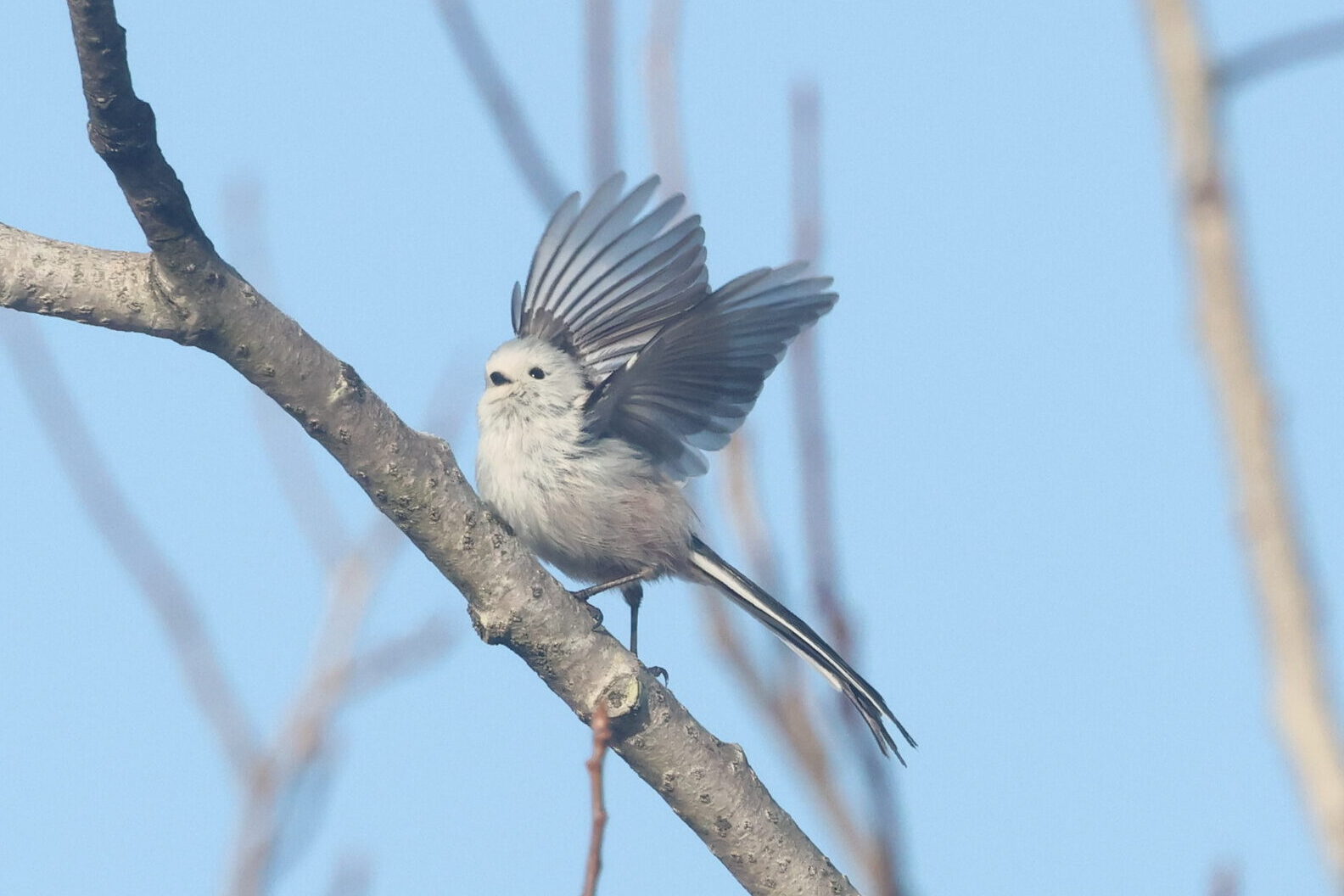
It is impossible to set foot in Hokkaido without finding the lovely Long-tailed Tit‘s image everywhere. From socks and hats to plush toys and key chains, this dainty, impossibly cute bird is high on the list for birders and non-birders alike. Long-tailed Tits are actually quite common and found throughout Eurasia. They feed mainly on insects and can travel in small flocks. They inhabit deciduous woodlands, scrublands, and even parks and farm fields. Individuals in the northern part of their range have completely white faces. In Japan, the place to find this subspecies is in Hokkaido.
We spent several days searching for this bird. In the winter, sap from trees can form icicles, and these little birds flock to the branches to feed. We waited at a few trees where they are known to congregate, but we didn’t have much luck. On our last day, we took a morning walk. The sky was a lovely blue, the snow in the fields had melted overnight, and the temperatures were cold, but not too bad. On our way back to the hotel, we spotted movement in a tree across the road. Sure enough, a lone Long-tailed Tit was flitting about the bare branches. After a few moments, it flew off to meet at least one other member of its flock. A lovely sighting to end our trip on.
3. Steller’s Sea Eagle
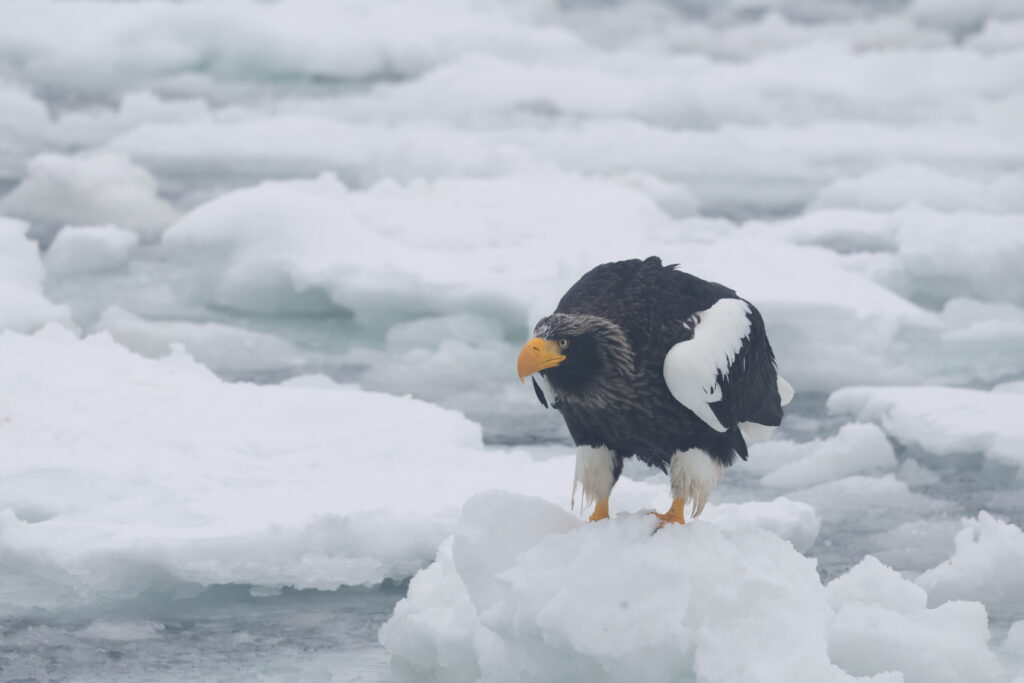
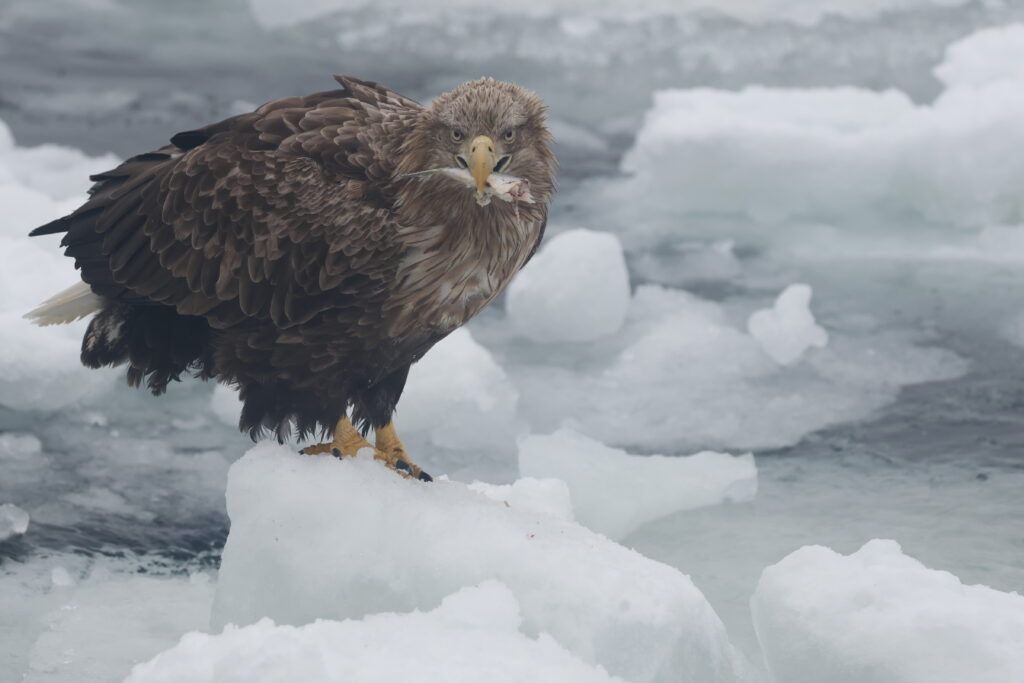
We left our hotel early this morning, driving past snow-covered fields, a large lake, and lovely forest to make it to our boat on time. Docking around 8:30 or so, the boat slowly began to fill with a few other passengers, all laden with cameras and binoculars. When the boat was full (there were about 20 of us), the engines roared and we began the slow ride out to sea. Along the way, we spotted a few Steller’s Sea Eagles and White-tailed Eagles in the distance. I was thrilled with the sighting, but had no idea what was yet in store for us.
After about 25 or 30 minutes, we came upon large fields of floating ice, dotted with both eagle species. I didn’t take the time to count, but I would estimate at least 60 or 70 individuals, plus dozens of Slaty-backed Gulls as well. Other boats were in the area, but it never felt crowded. We spent around an hour stopping, watching, and photographing these stunning eagles as they masterfully skimmed the water’s surface with their massive talons and plucked out fish one by one. This was a definite highlight of our trip.
4. Blakiston’s Fish Owl
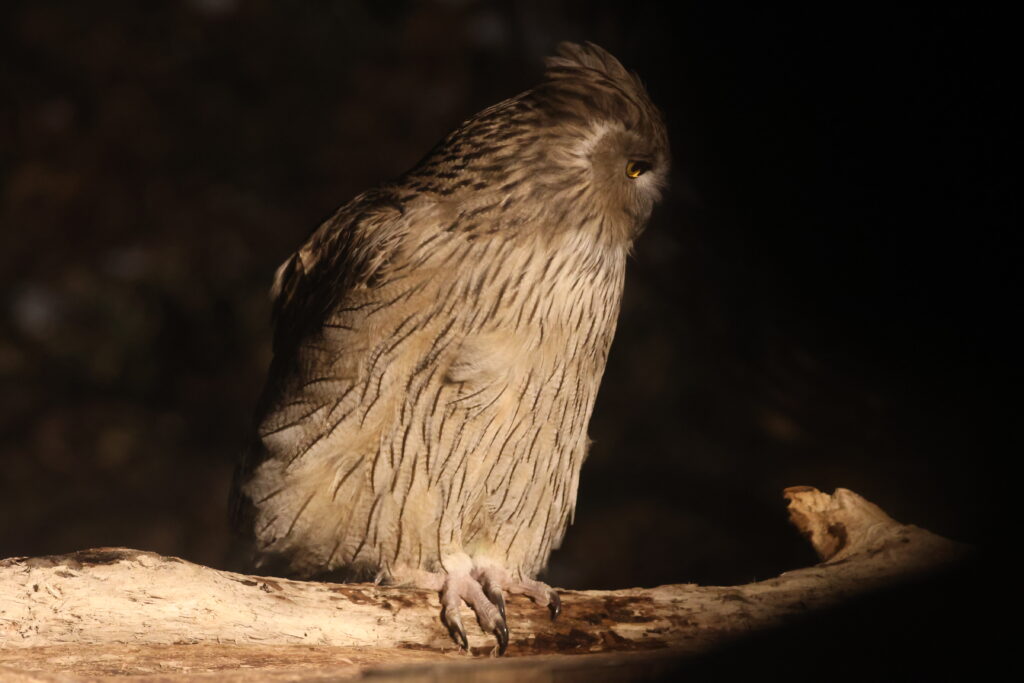
Owls hold a special place in my heart. So, naturally, one of our top targets for this trip was the Blakiston’s Fish Owl, one of the largest species of owls in the world. Though they can be found roosting, they are a species that is normally difficult to spot in the wild. Thankfully, a river runs just past the lovely lodge where we stayed for 2 nights. During the day, this clear waterway attracted such lovely birds as Crested Kingfisher and Brown Dipper. But at night, the owls took over.
At this particular hotel, they have set up a fishing station for the owls, which they bait each night. There is a one-eyed male owl that has learned to take advantage of these easy pickings. Both nights, we were able to watch this owl as it plucked fish from the station. The first night we had only a short look – about 5 minutes or so – before it flew off into the darkness. The second night, we first spotted it perched in a tree above the river. It soon spread its massive wings and glided down to a bare log. It fished and ate for about 45 minutes, delighting us with its beauty.
5. White-tailed Eagle
These spectacular raptors have a relatively wide distribution across Eurasia. Feeding on fish and water birds, they naturally spend much of their time near large bodies of water where food is in good supply. We saw several of these beautiful birds of prey all around Hokkaido – perched in trees, on cement barriers near the ocean, or flying overhead. Our best view, however, was watching dozens of them on the floating ice sheets at sea. They gracefully soared around our boat, deftly plucked fish from the water, squabbled with other eagles over a morsel, or just stood regally, as if posing for us. Raptors hold a special place in my heart and seeing these eagles, together with the Steller’s Sea Eagles and Slaty-backed Gulls, was a sight I will not soon forget.
6. Ezo Flying Squirrel
Though we didn’t get to see one of these amazing critters on this trip, they definitely deserve a spot on the top 10 list! I have only ever seen one flying squirrel, and that was during our last trip to Sri Lanka. While I would have loved to see the Ezo Flying Squirrel, the fact that we didn’t is just one more reason to return to Hokkaido.
The Ezo Flying Squirrel is quite possibly the cutest and most photogenic creature in the world. Its large, dark eyes, otherwise tiny features, and fluffy fur make it look like a cartoon character rather than a living, breathing animal. This endemic species is nocturnal. It is herbivorous and feeds on seeds, flowers, leaves, fruits, and more. It nests in tree hollows and holes, which they line with moss and other soft items. They can have a litter of 2 to 6 kittens. I can’t even imagine how cute a baby Ezo Flying Squirrel would be.
7. Red Squirrel
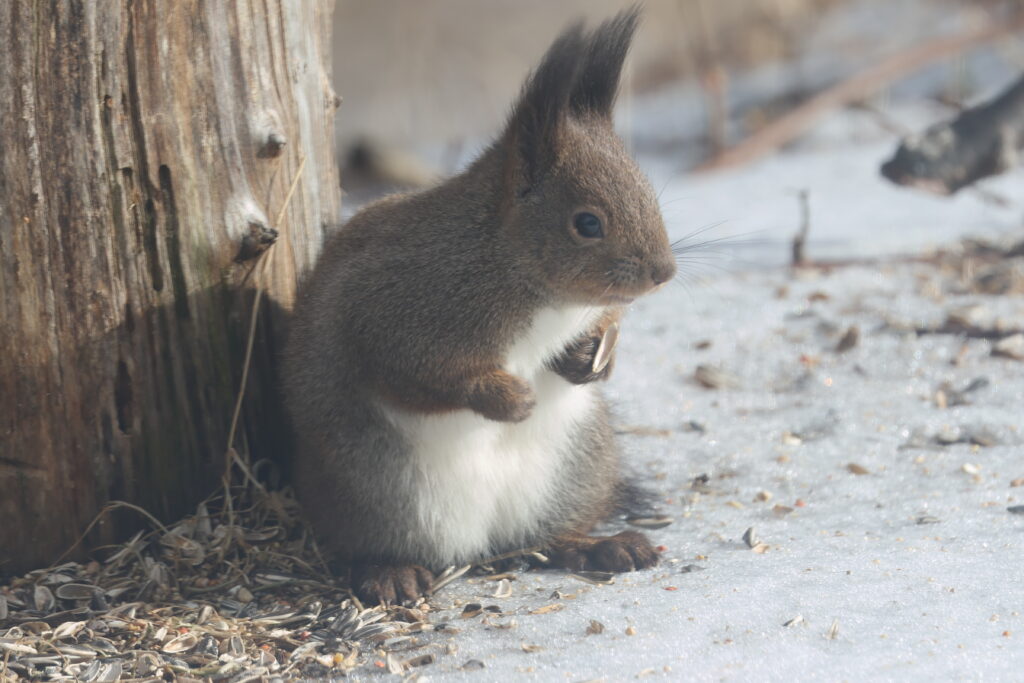
While we have been focused on birds for much of this list, we would be remiss not to mention some of the lovely mammals of the region. One of our favorites was the ubiquitous and adorable Red Squirrel. There are over 20 subspecies of the Red Squirrel. It has a wide distribution, is categorized as Least Concern by the IUCN, and is relatively common. Their cute faces, tufted ears, and boldness at the bird feeders make them fun to watch and photograph.
8. Ural Owl
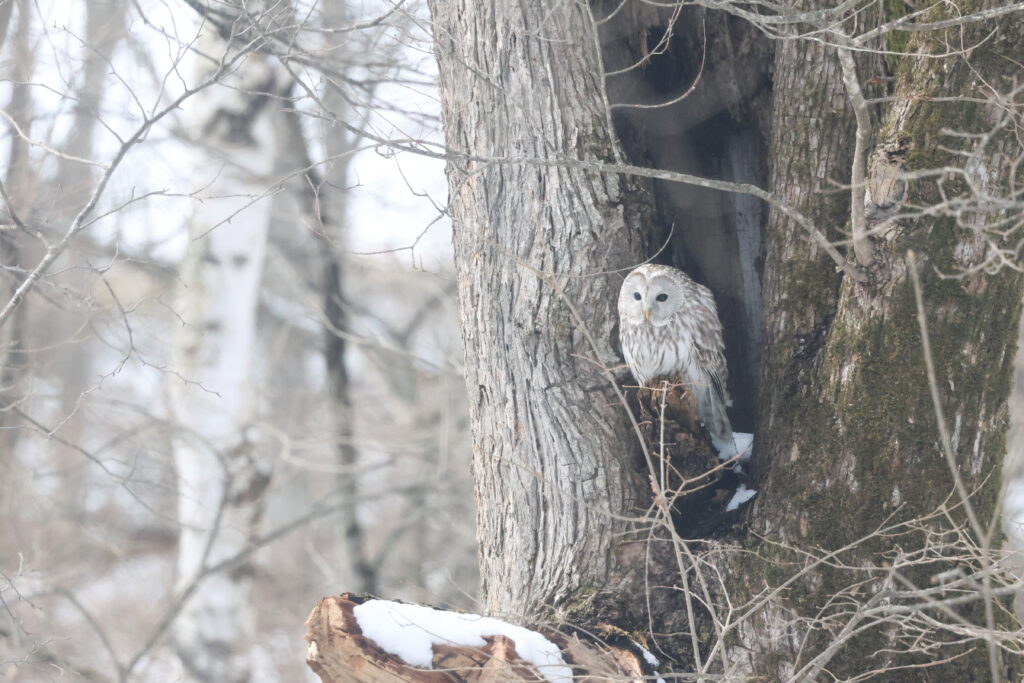
Dark eyes peer out from its pale, almost heart-shaped face. Otherwise, its mix of white, gray, and cream feather patterns allows it to blend in well with the tree hollow where it roosts. This relatively large owl feeds on comparatively small prey, including voles, shrews, moles, small birds, reptiles, and amphibians. We spotted this beauty in a forest along a snow-packed road. There was a photographer out there when we arrived, but otherwise, there was no one else around. We all stood watching this regal owl as it appeared to watch us in return. It scratched, preened, and occasionally turned its round head – perhaps its sharp ears picked up a sound we humans could not detect. A terrific sighting indeed.
9. Sika Deer
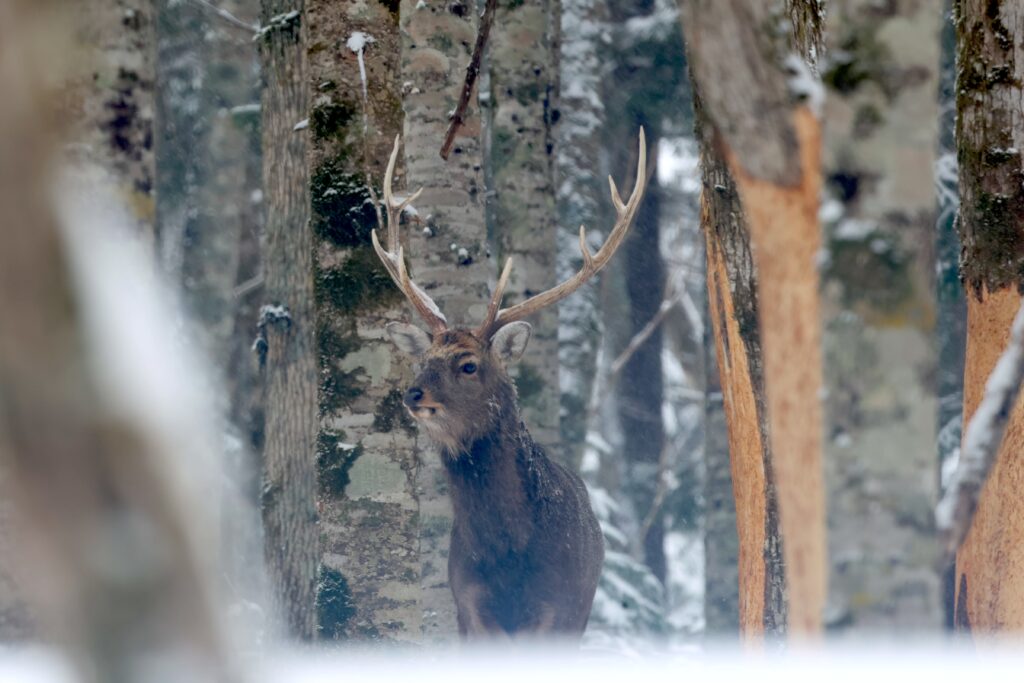
Sika Deer were quite a common sight around Hokkaido. We saw large herds along the marshes – our first stop after arriving in Hokkaido – together with a small flock of Snow Buntings. We had a chance to observe several in snow-covered forests as they ripped bark from the trees or shoved snow aside with their noses as they fed. The subspecies of Sika Deer found here is apparently one of the largest in the world. And they are very impressive. The males look absolutely regal as they stroll through the maze of trees covered in snow.
10. Ezo Red Fox
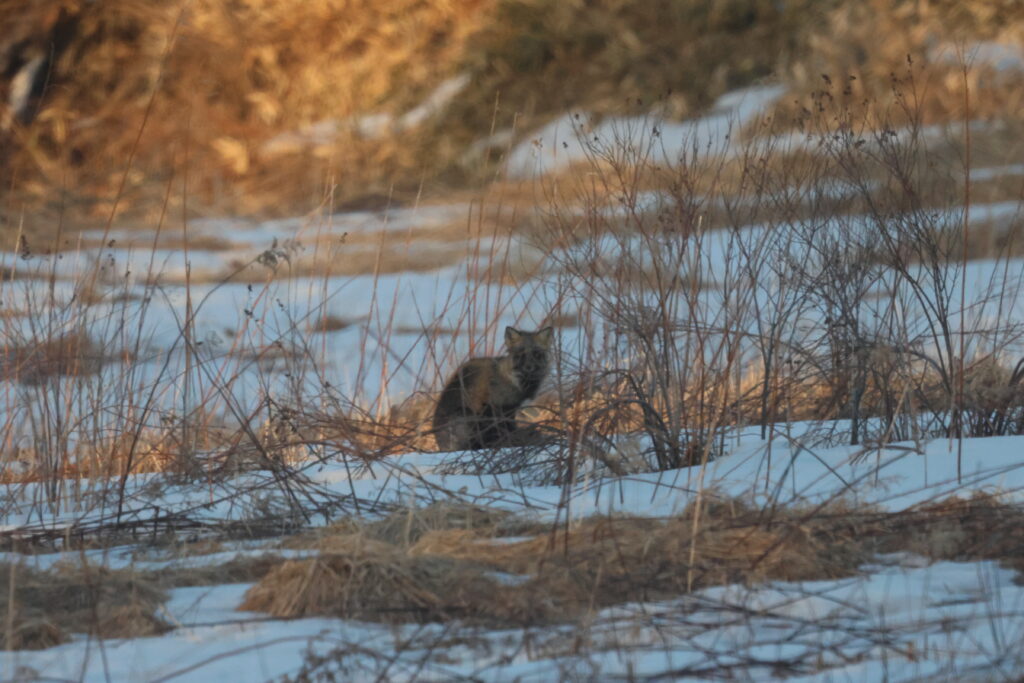
This lovely subspecies of the widely distributed Red Fox was surely a highlight of our trip. Over our six days in Hokkaido, we saw about as many foxes. Some were still in molt, changing between the dark brown fur and their stunning red coats. The best sighting was on our second morning, when one passed just in front of our hotel window. It was a brief look, but very close up, which made it really special. We loved watching them cross open fields painted white by the snow, or sit amongst the brown vegetation, nearly camouflaged by the natural browns and reds of these grasses and bushes in winter.
Though Whitehawk doesn’t run tours to Japan (yet), we do offer several tours to some other incredible countries in Asia, including Bhutan, Mongolia, and India. Please feel free to contact us if you would like to visit any of these spectacular birding, nature, and photography destinations.